

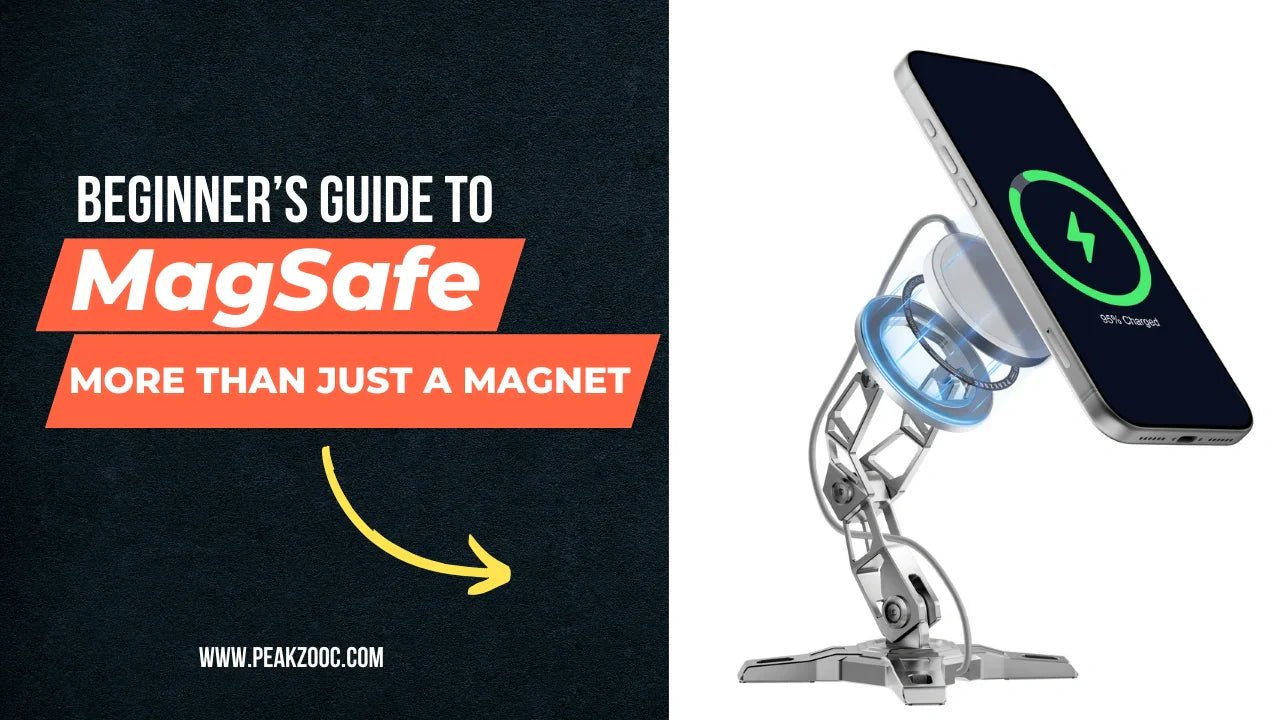
If you’ve owned an iPhone since the 12 series, you’ve heard of MagSafe. You probably think it’s just a fancy way to stick a charging puck to your phone. But if that’s all you see, you’re missing the point. At Peakzooc, we don't view MagSafe as a "feature." We view it as a mechanical interface. It’s the first time Apple turned the back of your device into a modular mounting system. For those of us obsessed with precision and the EDC lifestyle, MagSafe is the bridge between digital tech and raw, physical hardware.
1. A Brief History: From Safety to Modularity
The "MagSafe" name is a callback to the MacBook’s magnetic power connectors—a brilliant bit of engineering designed to save your laptop from a trip-wire disaster. When Apple revived this for the iPhone, they shifted the philosophy from "safety" to "universal attachment."
It’s a precision-aligned ring of N52 magnets embedded around the wireless charging coil. This simple addition creates a smart, tactile interface. It’s binary: it’s either snapped in with perfect alignment, or it’s not.

2. The Science of the "Click"
Forget the "magic" marketing fluff. Let’s talk about the physics. Starting with the iPhone 12, Apple built a polarized magnetic array into the chassis. Any high-quality MagSafe accessory—whether it’s a metal MagSafe wallet or a MagSafe grip—has a corresponding ring.
When they meet, they self-align with a satisfying, audible "snap." This solves the single biggest flaw in wireless charging: misalignment. No more waking up to a dead battery because your phone shifted 2mm to the left.
3. The Modular Power of the Ecosystem
While 15W charging is great, the real "flex" is the ecosystem. This magnetic foundation has birthed a new category of modular gear that fits a pro-level workflow:
The Secure Carry: A precision-milled metal MagSafe wallet that snaps on when you need it and pops off when you don't.

The Content Tool: High-strength MagSafe grips that turn your phone into a dedicated camera rig.
The Tech-Ready Shield: Such as iPhone 17 Pro case MagSafe designs, the core magnetic logic remains the same. It’s an investment in a system, not just a gadget.

4. Why We Engineer "Dumb" Stands (And Why They’re Better)
Most MagSafe stands on the market try to do too much by integrating cheap charging coils. We took a different path with the Peakzooc CNC Metal Stands. Here’s why a dedicated, non-charging stand is the superior choice for a serious desk setup:
Thermal Management: Wireless charging generates heat. If you’re on a 2-hour Zoom call, the last thing your iPhone needs is to be cooked by a charging coil.
Unwavering Stability: Electronics are light and hollow. Our stands are CNC-machined from solid blocks of 6063 aluminum. The weight is the feature. When you tap your screen, the phone doesn't move. It’s a tool, not a dock.
Unrestricted Placement: Free yourself from the outlet. Place your phone where it’s ergonomically correct, not just where the cord reaches.
5. Compatibility & The Qi2 Horizon
The "Snap" is going universal. All iPhones from the 12 to iPhone 17 Pro Max have it. And with the rise of Qi2, Android users are finally getting a taste of this magnetic standard.
Pro Tip: If you use a case, it must be a MagSafe-compatible case with internal magnets. A standard thick case is a wall that kills the magnetic flux. If you want the best grip, trust the metal-to-metal connection.
The Verdict
MagSafe has moved from a novelty to an essential part of the iPhone experience. It’s about precision, modularity, and removing friction from your daily life.
Ready to stop fumbling with cables? Explore our Peakzooc MagSafe Accessories or dive into our guide on building an Desk Setup with MagSafe.
FAQ: Hard Truths
Q1: Does MagSafe ruin your battery?
A1: No. Apple’s software manages the thermals. The real danger is cheap, uncertified chargers that run too hot.
Q2: Can I use it with an iPhone 17 Pro Max?
A2: Absolutely. We are already engineering our iPhone 17 Pro Max magsafe case and stands to be ready the moment the device drops.
Q3: Why choose metal over plastic?
A3: Because your $1,200 phone shouldn't be held up by a $5 piece of injection-molded plastic. Precision matters.


