

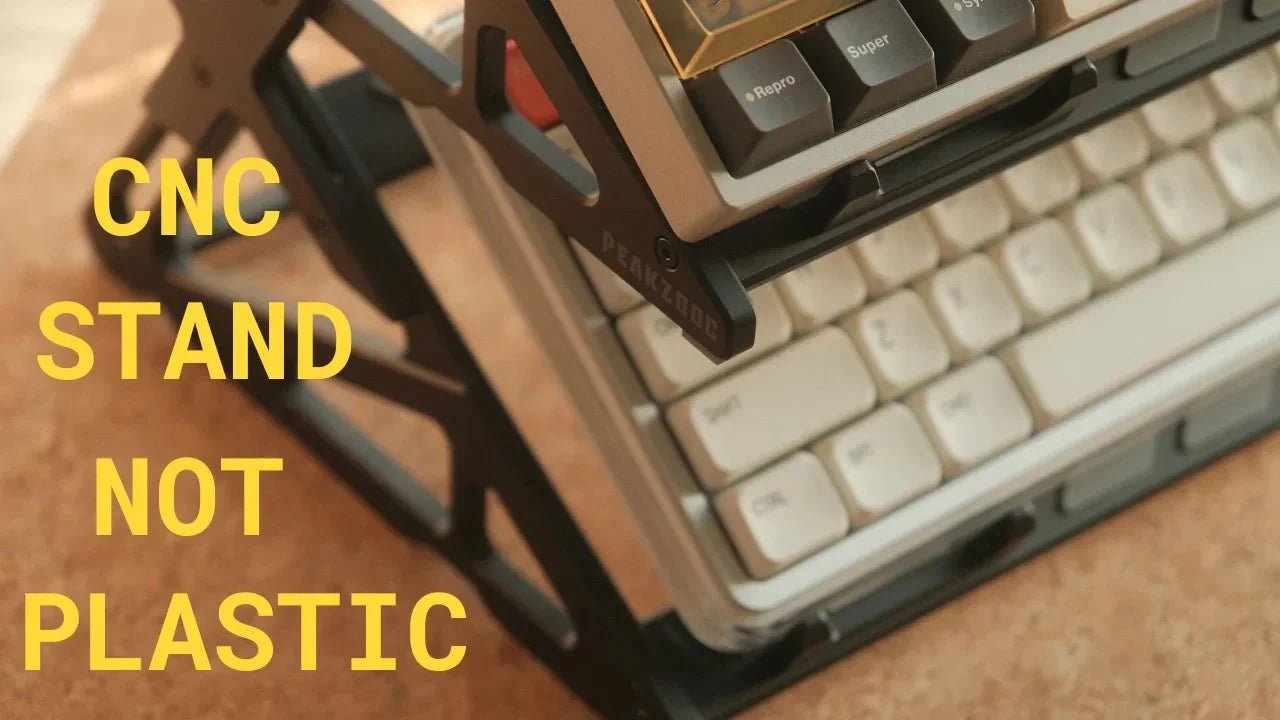
If you're into mechanical keyboards, you know the obsession—the perfect switch, the satisfying weight, the ideal keycap profile. We chase that perfect feeling. So why do most of us settle for flimsy plastic or 3D-printed stands to hold our prized collections? I did too, until the frustration drove me to build something better: a stand worthy of the keyboard it holds.
Finding a good stand isn't just about storage; it’s about stability, precision, and matching the quality of your setup. Let's break down what makes a stand work and what to look for.
1. Forget Acrylic and 3D-Prints. It's All About Density.
Most guides will tell you to find something "durable." That's the bare minimum. For a premium keyboard, the material needs to do more.
-
Acrylic looks clean for about five minutes. Then it becomes a static dust magnet and starts to look cloudy.
-
3D-Printed PLA/PETG feels like a prototype—light, hollow, and cheap. It vibrates with every keystroke.
The solution is dense, solid metal. A stand made from a block of CNC-milled aluminum, like ours, isn't just holding your keyboard. Its weight and rigidity anchor it. The low center of gravity means no wobble, no slide—just a rock-solid foundation. This is non-negotiable.

2. Stability Beats Gimmicky "Adjustability"
Lots of stands boast about adjustable plastic hinges. Every engineer knows a secret: every moving plastic joint is a future rattle or a point of failure. Unless you're constantly changing your typing angle, you don't need that headache.
Look for:
-
A fixed, optimized angle (around 6°) engineered for comfort.
-
Serious weight. If the stand is lighter than your keyboard, it will move. A heavy stand absorbs energy and stays put.
-
Mechanical locking over plastic friction. Simplicity is strength.
3. It Should Look Like It Belongs
Your desk has a vibe—minimalist, cyberpunk, industrial. Your stand should be a seamless part of that. A chunky plastic bracket underneath a sleek aluminum keyboard ruins the illusion.
-
Finish is key. Painted metal chips. Anodizing—the process we use—bakes the color into the aluminum, creating a surface that’s harder than the metal itself. It gives you that clean, matte, "tool" look that integrates with your other gear.
-
The design should disappear. A good stand elevates your keyboard (literally and visually), making it look like it's floating on your desk, not trapped in a cage.
Your Quick Buy Checklist:
-
✅ Material: Solid, CNC-milled aluminum or steel. Nothing hollow.
-
✅ Weight: Heavier than your keyboard.
-
✅ Base: Wide, with non-slip silicone pads (not foam).
-
✅ Finish: Anodized, not painted.
-
✅ Edges: Cleanly chamfered, not sharp or poorly finished.
Finally
You didn't spend months building the perfect keyboard to have it sit on a $15 piece of plastic. The stand is the final piece of the puzzle—the foundation. It should be an instrument in its own right, built to the same standard as everything else on your desk.
That was the goal when we built ours. It's not a gadget; it's the missing piece for a serious setup.


