


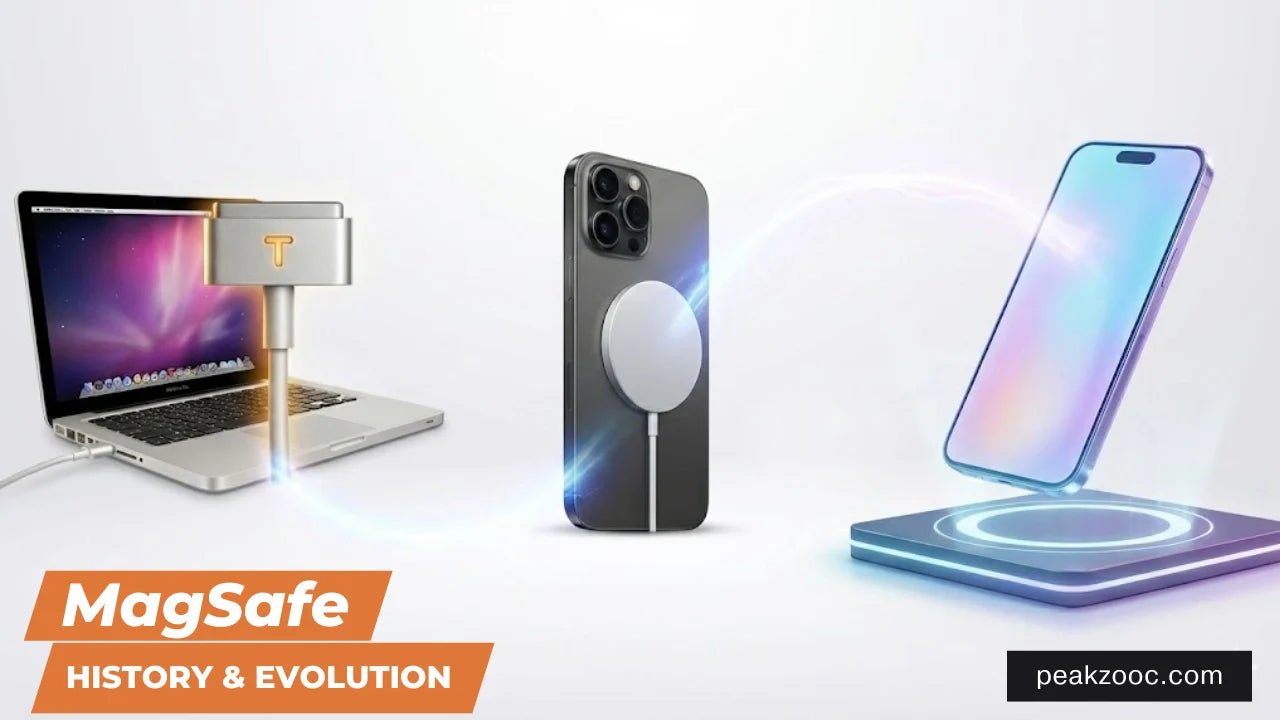
If you are a tech enthusiast, the word "MagSafe" likely triggers a very specific sound in your mind: The Click. That satisfying, mechanical snap is the sound of a perfect connection. But MagSafe wasn't always the modular ecosystem we know today. It began as a humble safety feature, disappeared, and then returned to revolutionize the way we carry our daily essentials.
At Peakzooc, we’ve watched this evolution closely. Why? Because MagSafe is the ultimate expression of our design philosophy—Modular, Durable, and Precise.

2006: The "Safety First" Era
The original MagSafe debuted on the MacBook Pro in 2006. At the time, its purpose was singular: Prevention of disaster. By using a magnetic connector instead of a physical plug, Apple ensured that if someone tripped over your power cord, the cable would simply snap away, leaving your expensive laptop safely on the desk.
It was a mechanical solution to a human problem. It was about detachment.
2020: The Pivot to "Modularity"
When Apple brought the MagSafe name back for the iPhone 12, the philosophy flipped 180 degrees. It was no longer about breaking away; it was about locking in.
By embedding a precision-aligned ring of N52 neodymium magnets around the charging coil, the iPhone transformed from a slab of glass into a modular hub. This changed everything for the Everyday Carry (EDC) community. Suddenly, your phone wasn't just a phone—it was a mounting point for wallets, stands, and battery packs.

The iPhone 17 Era: The Universal Standard (Qi2)
As we move into 2026 with the iPhone 17 Pro Max, MagSafe has reached its final form. It is no longer just an Apple feature; it has inspired the Qi2 universal standard.
This means the "magnetic interface" is now a global language. Whether you use an iPhone or a high-end Android flagship, the magnetic alignment ensures:
-
Zero Thermal Waste: Perfect alignment means less heat and faster charging.
-
Mechanical Integrity: Your gear stays exactly where you put it, whether on a CNC-milled phone stand or a rugged car mount.

Why Peakzooc Embraces the Magnet
Many brands treat MagSafe as an afterthought—a sticker hidden inside a plastic case. At Peakzooc, we treat it as an engineering challenge.
-
Material Science: Plastic absorbs heat; metal dissipates it. Our MagSafe stands and metal wallets are machined from aerospace-grade aluminum to ensure that while your phone is charging or docked, it stays cool and performs at peak levels.
-
Industrial Strength: We don't settle for "good enough" magnets. We use high-torque N52 arrays that ensure your iPhone 17 Pro Max stays anchored, even if you’re using it as a secondary display in a high-intensity workspace.
-
Modular Synergy: We designed our MechGuard Metal Wallet and Robotic Arm to work together. This is the "Everyday Valentine" we talk about—a relationship between your gear that makes your life frictionless.
The Future: Beyond Charging
The history of MagSafe shows us that the future of tech is Modular. We are moving away from monolithic devices and toward a world where your phone, your wallet, and your workspace "snap" together effortlessly.
Whether you are a minimalist looking for the slimmest metal magsafe wallet or a power user building a cyberpunk desk setup, MagSafe is the thread that connects your tools.
What’s in your daily carry? Explore the Peakzooc MagSafe Collection and experience the next step in the evolution.


